
The 2025 financial year was a pivotal year for Madrileña Red de Gas, both in regulatory and corporate terms, against a backdrop of transition to the third regulatory period and alignment with decarbonisation targets. Alongside the intensive regulatory review process driven by the CNMC, the company consolidated its position as a leader in sustainability, achieving the highest overall score in GRESB for the second consecutive year and retaining its five-star rating.
Furthermore, Madrileña Red de Gas made significant progress in cybersecurity and data protection by renewing its ISO 27001 certification, complying with NIS2 and effectively managing a security incident.
At the same time, the drive towards digital transformation continued through the Turing Project, the consolidation of a data-driven culture, and the cross-functional use of artificial intelligence (AI) as a driver of efficiency and productivity.
1.1Board of Directors
Carmen Gómez de Barreda Tous de Monsalve Chairwoman
Manuel Nofuentes Caballero Director
Yingqi Liu Director
Daniel Frank Hobson Director
Romain Thierry Victor Bruneau Director
Alexandre Pieyre Director
Kai Chen Director
Jan Matthijs Lakerveld Director
Shankar Krishnamoorthy Director
María Martín Secretary (non-director)
1.2Management Committee
Alejandro Lafarga Chief Executive Officer (CEO)
Rafael Fuentes Chief Legal Officer (CLO)
Inés Zarauz Chief Financial Officer (CFO)
David Ortiz Expansion Director
Félix Blasco Network Operations Director
Glen Lancastle Director of Systems and Customer Operations
María Vázquez Human Resources Director
1.3Regulatory Framework
Developments in 2025 and outlook for 2026
The 2025 financial year has been a pivotal year for the evaluation of the second regulatory period, enabling an analysis of the performance of the current model and the start of the process to define the foundations, principles and criteria that will govern the framework for the third regulatory period.
The year was marked by intense regulatory activity in the gas sector, against a backdrop of transition towards the third regulatory period (2027–2032) and the gradual adaptation of the regulatory framework to decarbonisation and energy transition goals. During the year, the regulator has promoted various initiatives aimed at reviewing the main elements of the remuneration and tariff framework, as well as assessing the performance of the current model, with the aim of strengthening the stability, predictability and consistency of the regulatory framework applicable to natural gas distribution.
On 3 January 2025, the National Commission for Markets and Competition (CNMC) published the timetable of regulatory Circular letters scheduled for processing in 2025. At the close of the 2025 financial year, none of the Circular letters relating to the gas system included in that timetable had received final approval, in accordance with the official schedule which sets the dates for the adoption of the remuneration and toll methodologies for the 2027–2032 period during the second and third quarters of 2026. Consequently, the regulatory proposals affecting remuneration for distribution and transmission, as well as the calculation of tolls, are currently being processed or awaiting a public hearing.
The 2025 financial year has been a pivotal year for the evaluation of the second regulatory period, enabling an analysis of the performance of the current model and the start of the process to define the foundations, principles and criteria that will govern the framework for the third regulatory period
Meanwhile, on 30 September 2025, Order TED/1062/2025 of 25 September was published, establishing the gas system charges, as well as the remuneration and fees for basic underground storage facilities for the 2026 gas year.
Developments in the remuneration framework for gas distribution
One of the most significant regulatory milestones of 2025 was the publication by the CNMC of the public consultation on the review of the remuneration methodology for natural gas distribution (CIR/DE/003/25), which represents the starting point for the design of the new regulatory framework applicable to the third regulatory period (2027–2032).
This consultation marks the starting point for the design of the new remuneration framework and opens up the discussion on structural issues such as the suitability of the current remuneration model and the outlook for the next regulatory period, the recognition of new energy sources, such as renewable gases, and the potential incorporation of remuneration parameters that incentivise investment in digital technologies.
This process is supplemented by the energy policy guidelines established by the Ministry for the Ecological Transition and the Demographic Challenge through Order TED/1318/2025 of 19 November (published on 21 November 2025). These guidelines must be taken into account by the CNMC when drafting the Circular letters for the 2027–2032 period and directly affect the remuneration methodologies for distribution and transmission, prioritising decarbonisation and the uptake of renewable gases.
In parallel, the CNMC published the provisional remuneration for the 2026 gas year (RAP/DE/011/25), the final year of the second regulatory period, providing short-term visibility to the sector in a context of transition between regulatory periods and allowing distributors to anticipate economic and financial impacts prior to the final definition and approval of the new regulatory framework.
Update to the methodology for calculating the Financial Remuneration Rate (TRF)
During 2025, significant progress was made in reviewing the methodology for the Financial Remuneration Rate applicable to regulated activities in the gas sector (Circular letter 9/2025). In this context, a public hearing on the amendment of the TRF calculation methodology was held in July 2025, during which the main financial parameters, the weighted average cost of capital and its alignment with the risk profile of the various regulated activities were analysed.
This process culminated at the end of the year with the approval of Circular letter 9/2025, which amends Circular letter 2/2019 and updates the methodology for calculating the TRF for the next regulatory period, whilst defining the rate for distribution, transmission and system operation activities in the electricity sector.
In this context, the regulations specify that, in the case of gas distribution, this parameter applies only to the setting of the rental price for meters and the limits on connection fees, thereby restricting its impact to strictly regulated assets. The TRF rate applicable to gas activities is expected to be approved in 2026 in a forthcoming Circular letter.
Evolution of gas tolls
As with the remuneration methodology, the regulatory process to review the toll methodology applicable to the third regulatory period (CIR/DE/004/25) began in 2025. Within this framework, the CNMC launched a specific public consultation on the 3PR toll methodology, with
the aim of gathering input from industry stakeholders to help define the new tariff framework. This methodology will also be affected by the guidelines set out in Order TED/1318/2025 of 19 November, which establishes energy policy guidelines for the CNMC regarding the processing of new Circular letters.
In parallel, and in accordance with the annual regulatory calendar, the CNMC has approved the access tariffs applicable to the 2026 gas year (RAP/DE/010/24), in accordance with the current methodology, providing regulatory continuity whilst the new 3PR tariff framework is being defined.
New strategic plan for the roll-out of smart meters
During 2025, the roll-out of smart meters in the natural gas network has also been promoted through the organisation of a public hearing for the approval of the digital meter implementation plan. This initiative sets out the procedure, timetable and minimum technical requirements for the gradual replacement of analogue meters with smart meters by 2033.
The plan aims to improve measurement accuracy, facilitate remote meter reading, optimise the operational management of the network and enhance the quality of service for consumers, as well as lay the foundations for greater digitalisation and integration of distributors’ information systems.
During 2025, the roll-out of smart meters in the natural gas network has also been promoted through the organisation of a public hearing for the approval of the digital meter implementation
Evaluation reports for the second regulatory period
As a significant development in 2025, the CNMC has published the draft specific evaluation report on gas distribution activity (RAP/DE/026/25) for the second regulatory period (2PR). The evaluation serves as a key reference for the design of the new regulatory framework,
as it helps to identify the strengths of the current model, potential inefficiencies and areas for improvement.
European regulations for the energy transition in the gas sector
On 15 July 2024, the ‘Gas Package’ was published, comprising Regulation (EU) 2024/1789 and Directive (EU) 2024/1788, aimed at facilitating the uptake of renewable gases (green gases) and integrating hydrogen. The Regulation is fully enforceable from 5 February 2025, whilst the Directive sets 5 August 2026 as the deadline for its transposition into national law.
During 2025, Spain has continued to adapt its regulatory framework through the aforementioned Order TED/1318/2025, the guidelines of which expressly incorporate the objectives of the Gas Package for the period 2027–2032. This regulatory framework is central to the modernisation of the European energy system and its alignment with decarbonisation targets.
What regulatory developments are expected in 2026?
Looking ahead to 2026, the regulatory focus in the gas distribution sector will be on defining the new remuneration framework and establishing the parameters that will govern the third regulatory period (2027–2032). The CNMC is expected to hold the first public hearing on the methodology in the first quarter of 2026, with final approval anticipated before the end of the year, with the aim of launching the new remuneration framework on a sound methodological basis. In this regard, continuity with the current remuneration methodology is anticipated, allowing for the incorporation of incentives for the development of renewable gases and the digitalisation of networks.
In parallel, the Financial Remuneration Rate is expected to be approved, which will mainly affect activities linked to gas distribution, such as the setting of meter rental prices and the limits on connection fees.
Finally, it is anticipated that the Gas Tolls Circular Letter will be finalised during 2026, whereby the toll calculation methodology applicable to the third regulatory period will be approved. This Circular letter will complete the set of regulatory frameworks governing gas distribution activity, providing greater certainty and economic stability for the period 2027–2032.
1.4Prevention of Criminal Offences
Madrileña Red de Gas’s risk management system for crime prevention is based on the general principles of:
- Legality.
- Due diligence.
- Integrity and responsible leadership.
- Compliance monitoring.
- Review and update.
- Systematic risk management adapted to changes.
In accordance with the provisions of Law 1/2015, which further amends the Spanish Criminal Code and regulates in greater detail the criminal liability of legal entities, establishing the obligation for corporations to implement effective measures in their organisations to prevent crimes within the scope of their activities, Madrileña Red de Gas has a robust criminal compliance management system, which consists of:
- A crime prevention policy.
- A criminal risk map.
- An internal prevention protocol.
The person responsible for this system is the Criminal Compliance Officer.
Conduct monitoring controls determine the information required and the course of action to be followed in situations involving regulatory breaches and/or practices contrary to the values and principles set out in Madrileña Red de Gas’s Code of Ethics and Anti-Corruption Policy.
In this regard, Madrileña Red de Gas has a whistleblowing channel in place (managed by an independent supplier) through which any member of our organisation —regardless of their position or responsibilities—, as well as any customer, supplier or third party, may report any irregularity or behaviour contrary to the law or to the rules and procedures established by the company, with the utmost guarantees of confidentiality and protection against reprisals.
Furthermore, in accordance with Law 2/2023 of 20 February, regulating the protection of persons who report regulatory breaches and combating corruption, Madrileña Red de Gas’s whistleblowing channel was updated in accordance with the advice and monitoring of the independent supplier. Additionally, the governing body has drawn up and approved policies and procedures to update the internal system for reporting irregularities, as required by the aforementioned law.
Specifically:
- The policy for managing reports of irregularities.
- The procedure for managing reports of irregularities.
- The appointment of a Head of the Internal Reporting System.
Madrileña Red de Gas updated its Whistleblowing Channel and adapted its system for reporting irregularities, thereby complying with the new Whistleblower Protection Act. As at 31 December 2025, Madrileña Red de Gas continuously monitors the obligations arising from Law 2/2023 of 20 February, specifically regarding the appointment and notification of the Head of the Internal Reporting System.
Madrileña Red de Gas continuously monitors the obligations arising from Law 2/2023 of 20 February, specifically regarding the appointment and notification of the Head of the Internal Reporting System
Furthermore, during 2025, the risk related to the offences included in the company’s risk map was reassessed in order to identify behaviours that could constitute a breach of the relevant regulations and give rise to liability. As a result of this assessment, the annual compliance review report and annual action plans addressing the identified needs were drawn up. In addition, relevant training on the prevention of criminal offences has continued to be provided; this is now delivered upon joining the company as part of the induction and onboarding programme.
1.5Corporate Risk Management
Madrileña Red de Gas has a robust risk management system, with a comprehensive approach, designed specifically for the company. This system enables it to identify, prioritise and implement measures and/or controls aimed at recognising, preventing, mitigating or controlling the risks it faces.
The Audit and Risk Committee reports directly to the Board of Directors and operates in accordance with its internal regulations, which define its objectives, functions and composition. This committee comprises representatives from the Board of Directors of each of the four shareholders, several members of the Management Committee and the risk management department.
The agenda items discussed at the committee’s regular meetings, which are held prior to every meeting of the Board of Directors, are agreed upon internally at the beginning of each new financial year. Key recurring topics include monitoring the corporate risk map, identifying and tracking the most significant risks, and analysing the controls in place and the mitigation plans that have been established or proposed. It also addresses issues relating to the audit of the financial statements, audits of the integrated prevention, environmental and quality system, and other matters linked to sustainability, such as the results of the GRESB report, the preparation of the sustainability report, the assessment of the governing bodies’ competencies in sustainability matters, and the self-assessment of their performance in this area.
The agenda also includes the analysis of insurance coverage policies, the policy on the prevention of criminal offences, monitoring the progress of non-conformities identified in previous audits, as well as the review of the results of the carbon footprint report and decarbonisation strategies. In the area of technological risks, particular attention is paid to cybersecurity risk, audits of the information security management system, and the analysis of risk materialisation events, such as significant operational incidents, power cuts, or cyberattacks resulting in information security breaches.
The integration of the risk management policy within the company has been articulated through the gradual implementation of cross-functional risk analyses, involving the business units most closely linked to the affected processes. Similarly, risk management features on the agenda of the Management Committee’s regular meetings.
Madrileña Red de Gas’s risk map covers a wide range of risks, focusing on the ten most material risks
At present, Madrileña Red de Gas’s risk map covers a wide range of risks, focusing on the ten most material risks, which have been assessed based on the following criteria:
- The probability of a risk occurring.
- The combined impact on net present value and reputational impact. The impact on net present value takes into account both the direct economic impact over the next twenty years and potential penalties.
The risk map addresses emerging risks through regular updates to its content. Furthermore, it establishes new high-level controls in addition to those already in place. The action plans implemented help to mitigate the consequences of these risks.
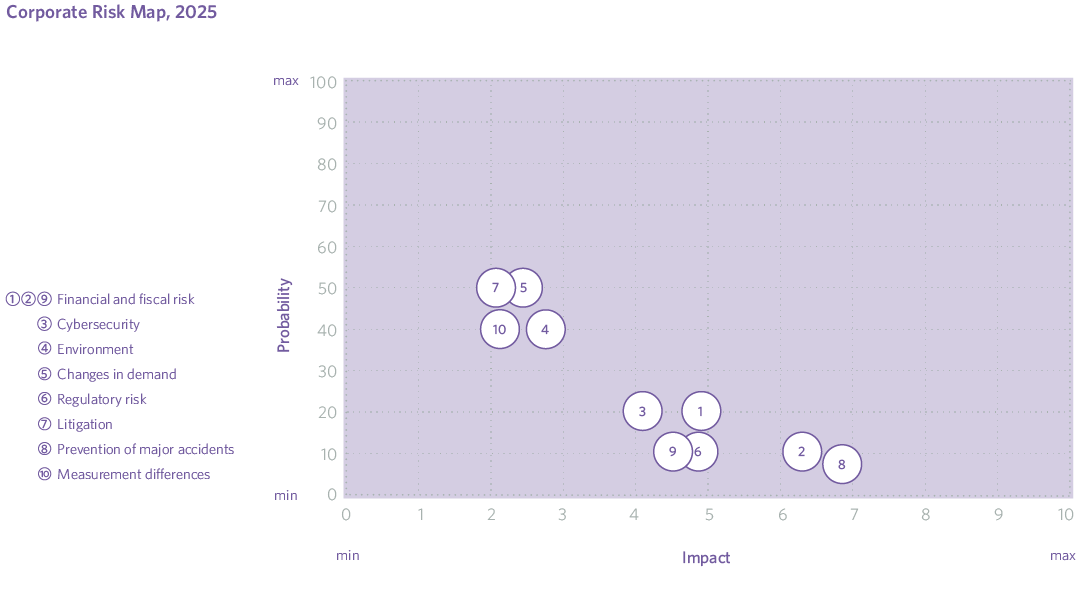
Building on the work done in the previous financial year, progress was made in 2025 in identifying, defining and assessing various risks, through detailed analyses of their contextual conditions and the potential consequences should they materialise. In parallel, the organisation has developed and strengthened a strategy aimed at preventing and mitigating the potential impacts associated with these risks, with the aim of anticipating them and minimising their effects on operations, people and the organisation as a whole.
1.6Sustainability
Madrileña Red de Gas has once again reaffirmed its sector leadership in Spain by achieving the highest possible rating in the last financial year: 100 points out of 100 in the GRESB assessment
After ten years of uninterrupted participation and having achieved outstanding scores in the three previous editions (96, 100 and 100 out of 100), Madrileña Red de Gas has once again reaffirmed its sector leadership in Spain by achieving the highest possible rating in the last financial year: 100 points out of 100 in the GRESB assessment. This result has enabled it to renew, for the fifth consecutive year, the prestigious five-star rating, a distinction reserved solely for the top 20% of companies globally, and which attests to the strength of its performance in sustainability, governance and responsible management.
This result positions Madrileña Red de Gas as an absolute benchmark in sustainability at an international level, a position the company has retained for the second consecutive year. This recognition consolidates its leadership and highlights the strength, consistency and coherence of its management model in an increasingly demanding and competitive environment.
In this edition, and in line with a sustained track record of excellence, Madrileña Red de Gas not only maintains the top five-star rating, but is once again ranked number one globally across all sectors, outperforming all participating companies from the various sectors and regions assessed.
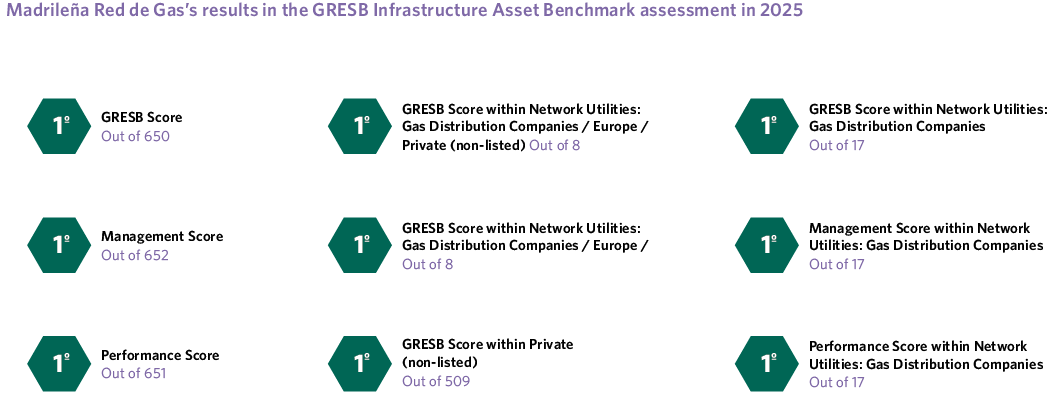
Through this recognition, Madrileña Red de Gas reaffirms its commitment to responsible, transparent management focused on generating a positive impact, integrating sustainability as a strategic pillar of its business model. The company views sustainability not as an isolated objective, but as a continuous process of improvement, which makes a decisive contribution to strengthening energy security, operational efficiency and the social and environmental development of its surrounding communities.
Through this recognition, Madrileña Red de Gas reaffirms its commitment to responsible, transparent management focused on generating a positive impact, integrating sustainability as a strategic pillar of its business model
Furthermore, the results provide an insight into both the company’s progress compared to previous years and its level of maturity in ESG (Environmental, Social and Governance) best practices, as well as a comparison with other companies in the same sector. Madrileña Red de Gas is working to integrate the 2030 Sustainable Development Goals into its strategy.
Verified Sustainability Report
In 2025, Madrileña Red de Gas produced its fourth Sustainability Report, covering the 2024 financial year, in accordance with GRI (Global Reporting Initiative) standards. This report has successfully passed the independent external verification carried out by an independent third
party, which endorses the reliability and quality of the published information. The report comprehensively covers the company’s performance in the economic, social, environmental and corporate governance spheres, incorporating, as in the previous financial year, the specific ‘Oil & Gas’ sector standard.
The preparation of the Sustainability Report serves a number of strategic objectives, including, in particular, improving the management of reputational risks and brand image, strengthening the analysis and management of risks and opportunities associated with social responsibility, providing relevant and transparent information to stakeholders, and establishing a roadmap to address the main sustainability challenges, such as climate change and the circular economy, thereby actively contributing to the United Nations Sustainable Development Goals.
Transparency and communication
During 2025, Madrileña Red de Gas significantly strengthened its focus on corporate communication, particularly in the area of sustainability. In this context, and following the excellent result achieved in the GRESB assessment, a coordinated communication strategy was launched involving various areas of the organisation, with particularly active collaboration from the Expansion department and the support of the external communications agency.
This coordination enabled the drafting and publication of a press release on the corporate website, as well as the development of specific content for social media, with a particular focus on dissemination via LinkedIn. Furthermore, and as a new development compared to previous years, the scope of communication was expanded by sending personalised communications to relevant organisations and institutions, as well as to key clients, supplemented by the distribution of an explanatory leaflet detailing the recognition received.
As a result of these actions, the news regarding the GRESB result achieved widespread coverage across various digital media, helping to strengthen the Company’s external visibility and positioning as a leader in sustainability.
Furthermore, during the first half of 2025, Madrileña Red de Gas submitted the information requested by its shareholder PGGM for the third time, in compliance with the requirements of the SFDR Regulation.
Furthermore, with the aim of publicising the strategies and actions developed in the area of sustainability, Madrileña Red de Gas keeps the content of the “Commitment to Sustainability” section of its corporate website constantly updated. This section has been structured into three main blocks, which clearly and accessibly outline the company’s priority areas of action in this field: corporate governance, communication and transparency, and social and environmental issues, thereby reinforcing its commitment to responsible, transparent management aligned with best practices in sustainability.
1.7Cybersecurity
Cybersecurity is a strategic priority for Madrileña Red de Gas. As an operator of critical infrastructure, the protection of operations, customer data and the continuity of supply is an essential part of its corporate responsibility. In 2025, the company decisively strengthened its security model, consolidating a culture focused on prevention, resilience and continuous improvement.
Cybersecurity is a strategic priority for Madrileña Red de Gas. As an operator of critical infrastructure, the protection of operations, customer data and the continuity of supply is an essential part of its corporate responsibility
Throughout the financial year, eight key milestones were implemented that have significantly strengthened the organisation’s overall protection framework:
- Disaster recovery simulation.
- Network penetration and external intrusion testing.
- Improvement of security dashboards and reporting.
- Implementation of a SASE (Secure Access Service Edge) solution.
- Implementation of improvements to OT network monitoring
- Renewal of ISO 27001 certification and ensuring compliance with NIS2.
- Cybersecurity training and awareness.
- Cybersecurity audit and maturity assessment in IT and OT environments.
In September 2025, a security incident was detected in the company’s IT infrastructure. The established internal protocols were immediately activated, leading to urgent checks and a thorough review of the affected systems. As a result of this analysis, it was confirmed that certain customer identification and contact details, including the CUPS (Universal Supply Point Code, equivalent to MPAN) number, had been leaked; however, under no circumstances were bank details, access credentials or passwords compromised.
The company immediately informed all potentially affected customers via email and SMS, supplementing this action by publishing the relevant information on its corporate website. Furthermore, the incident was promptly reported to the relevant authorities, including the National Cybersecurity Institute (INCIBE), the Spanish Data Protection Agency and the Civil Guard, with transparent, proactive and continuous communication maintained at all times. As an additional measure, the security of the Virtual Office was strengthened through the implementation of a two-factor authentication system.
In September 2025, a security incident was detected in the company’s IT infrastructure. The established internal protocols were immediately activated
The incident, which was managed effectively and satisfactorily, has provided a further boost to the company’s commitment to the continuous improvement of its security systems. The experience has highlighted the need to expand coverage in certain layers of the existing defence model, based on device encryption, SIEM-SOC, multi-factor authentication (MFA), endpoint detection and response (EDR), network isolation and penetration testing, thereby enabling the acceleration of actions already outlined in the strategic roadmap.
In this context, third-party monitoring mechanisms have been strengthened, systems’ exposure to the internet has been reduced, data retention on ancillary systems has been limited, and the use of multi-factor authentication has been extended to all environments. Similarly, controls over privileged users have been strengthened, collaboration with the SOC has been reinforced, the updating of obsolete software has been prioritised, and response protocols have been adjusted with the aim of optimising response times to potential future incidents.
At Madrileña Red de Gas, cybersecurity is viewed not only as a regulatory obligation, but as a strategic responsibility and an ongoing commitment to customers and society as a whole. The 2025 financial year has been a year of progress, learning and consolidation, during which internal capabilities have been significantly strengthened with the aim of ensuring the company’s security, operational continuity and resilience.
The 2025 financial year has been a year of progress, learning and consolidation, during which internal capabilities have been significantly strengthened with the aim of ensuring the company’s security, operational continuity and resilience
1.8Information Security and Personal Data Protection
In 2025, Madrileña Red de Gas successfully completed the certification of its Information Security Management System in accordance with the current ISO 27001 standard, thereby reinforcing its framework for information control and protection. This system is fully aligned with the Company’s Integrated Management System and incorporates the personal data protection management model within its
scope, ensuring consistent and robust information security management.
Furthermore, certification has been achieved by extending the initial scope to include the logistics facility in Alcorcón, reinforcing the organisation’s commitment to information protection and the continuous improvement of its management systems.
In 2025, Madrileña Red de Gas successfully completed the certification of its Information Security Management System in accordance with the current ISO 27001 standard, thereby reinforcing its framework for information control and protection
During the 2025 financial year, and in line with the previous year, Madrileña Red de Gas has continued to allocate financial, technical and human resources to the development of various initiatives aimed at strengthening the system.
Throughout the financial year, information security performance remained stable, although two significant incidents occurred that required specific management. Firstly, the nationwide power cut in April, and secondly, an information security breach in September. Both incidents were managed in accordance with established procedures, enabling lessons to be learnt and preventive and response measures to be strengthened, with the aim of continuing to improve the system’s resilience and robustness.
In 2025, the management of personal data protection has focused primarily on addressing data subjects’ rights, resolving enquiries and managing incidents, many of which were linked to the interpretation of current regulations.
Madrileña Red de Gas has appointed a Data Protection Officer, who acts as the highest authority on this matter within the organisation and participates actively in the main governing bodies. In addition, the company has appointed a Head of the Information Security Management System, as well as a Head of Technical Security, supported by a team of specialist administrators, ensuring a robust and appropriate governance structure for the comprehensive management of information security and personal data protection.
Furthermore, based on the information security and personal data protection policies, Madrileña Red de Gas has management manuals comprising more than eighteen information security and personal data protection procedures. These procedures are subject to periodic reviews to ensure their content remains up to date.
Madrileña Red de Gas has management manuals comprising more than eighteen information security and personal data protection procedures
The information security and personal data protection management model provides for interaction with stakeholders through various channels:
- Publication on the website of the information security and personal data protection policies, as well as information on the processing of personal data intended for data subjects, the dissemination of which is further reinforced through the various communications sent to users.
- Active management of the Data Protection Officer’s mailbox, which has received a significant number of requests.
- Employee awareness and training activities.
- Interaction with bodies and authorities, such as the Spanish Data Protection Agency (AEPD) and the National Cybersecurity Institute (INCIBE).
Furthermore, the following actions, amongst others, are fully integrated into the management system:
- Establishment of specific contractual clauses regarding information security and personal data protection, and identification of critical suppliers from an information security perspective.
- Coordination with data processors on data protection matters through meetings, standardisation of criteria and agreements on best practices.
- Monitoring of information security and data protection performance across the supply chain via the supplier portal, including the assessment of the maturity of their privacy policies and the corresponding audit reports.
- Recording and investigating information security and data protection incidents, as a basis for implementing continuous improvements.
- Reassessment of the risks associated with the processing of personal data as a result of the security breach that occurred.
- Commencement of the review of the cybersecurity contingency plan, incorporating the improvement measures derived from the drill carried out and the experience gained following the actual activation of the plan.
- Continuation of work to bring the management model into line with the requirements of the NIS 2 Directive.
Nationwide power cut
In April 2025, a nationwide power cut occurred, affecting Spain, Portugal and parts of southern France as a result of an abrupt interruption in electricity generation. This incident had an impact on the operations of Madrileña Red de Gas, although no significant information security incidents were recorded.
The main impact revolved around access to certain corporate systems, without significantly affecting the operations or data integrity of critical systems, with the exception of the SCADA system, which experienced access limitations. Essential services, such as the emergency call centre and the SAP system, remained operational, albeit with occasional restrictions on remote access. Field services continued to operate with minimal disruption.
Customer service was maintained through the activation of contingency plans, with only a temporary reduction in the volume of interactions being detected. The incident highlighted the robustness of Madrileña Red de Gas’s technological infrastructure, in particular the support provided by cloud services and the use of backup power systems, as well as the need to strengthen internal and external communication protocols in the face of this type of situation. As a result of the analysis carried out, it was agreed to adopt additional measures aimed at strengthening the organisation’s resilience.
Security breach
In September 2025, Madrileña Red de Gas identified a security breach involving unauthorised access to personal data of customers and users. The procedures established in the Information Security Management System (ISMS) were immediately activated, including the measures set out in the cybersecurity emergency plan, thereby containing the incident, complying with applicable legal obligations and notifying the relevant authorities.
In September 2025, Madrileña Red de Gas identified a security breach involving unauthorised access to personal data of customers and users
The 2025 financial year closed without any new incidents affecting information security or the protection of personal data, nor were there any additional requests for information from the AEPD. This positive development is reflected in the ISMS management indicators for year-end 2025.
1.9Project Turing: Towards a Data-Driven Organization
1.9 PROJECT TURING: TOWARDS A DATA- DRIVEN ORGANIZATION In 2024, Madrileña Red de Gas launched the Turing Project, a strategic initiative aimed at consolidating the company as a fully data-driven organisation. The project has the firm backing of senior management and a Data Governance Committee reporting directly to the CEO, reflecting the strategic importance attached to advanced information management.
The main goal of the Turing Project is to strengthen data-driven decision-making, increase operational efficiency and contribute to enhancing the business’s competitiveness.
The initiative is being implemented through a three-year master plan and is led by a multidisciplinary team, with active participation from all business units. During the first year, efforts focused on defining and consolidating the data strategy, making progress on key milestones such as:
The main goal of the Turing Project is to strengthen data-driven decision-making, increase operational efficiency and contribute to enhancing the business’s competitiveness
- The creation of a single corporate data dictionary.
- The implementation of a data governance model that guarantees the quality, traceability and consistency of information.
- The integration of key information into a corporate data lake.
- The standardisation of operational and management reports, agreed upon and validated by all areas of the organisation.
This first year of deployment has laid the foundations for a robust model that not only organises and structures corporate information, but also significantly transforms the way data is managed and used in the company’s day-to-day operations.
This progress has been achieved through the gradual migration of the main financial and economic, commercial, project, invoicing, distribution, asset management and other key areas to a corporate data lake. In the 2025 financial year, the 18 main reporting structures were developed within this environment, the ETL (extract, transform and load) architecture was defined and implemented, and a significant proportion of the business’s critical data is now integrated into the new ecosystem.
The new architecture enables the automated daily intake of information from multiple sources, consolidating the data into a single, robust and scalable environment. As a result, existing reporting solutions that had become redundant have been phased out. In many cases, data processing times for report generation have been reduced from several days to just minutes.
The adoption of this model has led to a substantial improvement in data governance and quality, reducing inconsistencies, increasing data traceability and facilitating more agile, reliable and consistent access to corporate information.
The adoption of this model has led to a substantial improvement in data governance and quality, reducing inconsistencies, increasing data traceability and facilitating more agile, reliable and consistent access to corporate information
Thanks to this transformation, processes that previously required several hours of preparation and calculation can now be carried out in a matter of minutes, which has significantly increased team productivity and enabled more advanced, dynamic and decision-oriented analyses.
Likewise, performance in data utilisation and reporting has been significantly optimised, including reports intended for regulatory bodies and external institutions.
Overall, this project represents a key milestone in the evolution towards a more digital and data-driven organisation, with greater capabilities to anticipate, control and respond to future challenges.
Artificial Intelligence as a productivity tool across the organisation
Beyond specific use cases, Madrileña Red de Gas has taken a further step in 2025 with the deployment of Artificial Intelligence as a cross-functional productivity tool.
Madrileña Red de Gas has taken a further step in 2025 with the deployment of Artificial Intelligence as a cross-functional productivity tool
Throughout the year, an internal campaign of workshops and short training sessions has been developed to train teams in the responsible and efficient use of AI as an assistant in day-to-day tasks. Key areas in its scope include:
- Analysis of documents and regulations.
- Drafting of documents and reports.
- Exploratory data analysis and forecasting.
- Executive summaries and structuring of complex information.
- Information search and synthesis.
This initiative not only boosts individual efficiency, but also fosters a new working culture supported by intelligent tools, freeing up time for activities with greater added value.
Towards a mature and decentralised model
The third year of the Turing Project will focus on deepening advanced analytical capabilities and evolving towards a decentralised model, in which the business units themselves take on a leading role in driving data-driven initiatives, with a greater degree of autonomy and supported by staff with progressively greater expertise in strategy and analytics.
Through the Turing Project and the progressive integration of Artificial Intelligence into both its processes and its organisational culture, Madrileña Red de Gas reinforces its commitment to innovation, operational excellence and informed decision-making. This approach lays the foundations for a more efficient and competitive management model, equipped to successfully tackle the future challenges facing the business and the energy sector.