
Madrileña Red de Gas has significantly strengthened its commitment to decarbonisation, promoting, among other initiatives, the ECO Label and its active participation in the Gas Verde Sí platform, both aimed at raising awareness of the role of renewable gases and positioning the gas infrastructure as a lever for the energy transition.
In the environmental sphere, another highlight of 2025 is the consolidation by the company of its ISO 14001 certification. In addition, it has calculated its carbon footprint across scopes 1, 2 and 3, and reinforced its commitment to reducing methane emissions by joining the OGMP 2.0 initiative.
All of this confirms that the gas network constitutes a key infrastructure, ready and fully aligned with the goals of the energy transition.
5.1Progress and Forecasts in National Energy Regulation
Residential sector
In addition to the review relating to the amendment of the Technical Building Code (CTE), regulatory activity in the residential sector is focused on adapting the national regulatory framework to comply with European requirements arising from the Energy Performance of Buildings Directive (EPBD). In this context, the following developments are planned for the coming years:
Regulatory activity in the residential sector is focused on adapting the national regulatory framework to comply with European requirements arising from the Energy Performance of Buildings Directive (EPBD)
- Ecodesign regulation: technical work is continuing within the EU. However, the European Commission is not expected to present a formal proposal before the first half of 2026.
- Regulation on Thermal Installations in Buildings (RITE): the public consultation process on the regulatory text is scheduled to open during the first quarter of 2026, which will allow the process of updating and adapting it to the new energy efficiency requirements to begin.
- National Building Renovation Plan (PNRE) 2026: the Ministry of Housing and Urban Agenda (MIVAU) has submitted a first draft to the European Commission. The deadline for submitting the final plan is 31 December 2026.
- Amendment to the Technical Building Code (CTE) – Phase 2: its implementation is scheduled for the second half of 2027, with the aim of complying with the EPBD obligations applicable from 2028. This phase will introduce the requirement for zero-emission buildings and the definition of new limits on energy consumption and emissions. Prior to this, the document relating to CO2 emission factors and the primary energy conversion coefficients for the various energy sources will need to be approved.
Mobility
In the field of sustainable mobility, during the financial year Madrileña Red de Gas has carried out an exhaustive monitoring of the Draft Sustainable Mobility Act following its approval by the Plenary Session of the Congress of Deputies. This regulatory framework aims to transform the transport model in Spain, orienting it towards criteria of efficiency, sustainability and territorial cohesion.
Madrileña Red de Gas has carried out an exhaustive monitoring of the Draft Sustainable Mobility Act following its approval by the Plenary Session of the Congress of Deputies
The strategic pillars of this law, in which the gas sector plays a key role as a supplier of clean energy for heavy and maritime transport, are structured around the following objectives:
- Development of an integrated system: defining the general principles for safe, sustainable, accessible and inclusive mobility, supported by digitalisation and ensuring reasonable costs for the end user.
- Multimodality and logistics: to promote an efficient and resilient multimodal freight transport system, fostering sustainability within logistics chains and optimising the use of infrastructure.
- Institutional capacity: providing public administrations with the technical, regulatory and operational tools necessary for the effective implementation of the integrated mobility system.
- Governance and transparency: strengthening coordination and cooperation mechanisms between the different levels of government for the design, planning and management of transport and infrastructure policies.
- Stable funding: to establish a model for the central government’s participation in the funding of urban transport, based on criteria of equality, stability and proportionality.
5.2Natural Gas for Vehicles
During 2025, natural gas for vehicles continued to demonstrate its importance as a key alternative within sustainable mobility. As in the previous year, the increase in consumption was driven mainly by the maritime transport sector.
With regard to land transport, market trends reflect a clear shift towards professional use. Whilst the passenger car and light vehicle segment has been limited by the limited availability of new models from manufacturers, the heavy goods and passenger transport sectors continue to demonstrate their confidence in natural gas for vehicles.
Registration figures in Spain for 2025 confirm this trend, with a total of 793 natural gas-powered vehicles registered. Market performance has been particularly positive in the Liquefied Natural Gas (LNG) bus and truck segments. In the case of buses, registrations remain stable, with an increase of more than 20 units compared to 2024. Meanwhile, LNG trucks continue to rise, with 24 additional units compared to the previous year. In contrast, registrations of Compressed Natural Gas (CNG) trucks have fallen, following the same trend observed in the light vehicle segment.
A highlight of the financial year has been the progress made in decarbonisation, driven in particular by the introduction of biomethane. Natural gas is no longer considered merely a transition fuel, but has established itself as an alternative which, through the growing integration of renewable gases into the network, enables a significant reduction in the carbon footprint without requiring modifications to existing vehicle fleets.
In the Community of Madrid, the distribution sector of Madrileña Red de Gas, it is evident that local authorities continue to rely on Natural Gas for Vehicles (NGV) for street cleaning and waste collection services. A notable example this year has been the launch of a new service station by URBASER in the Latina district, designed for refuelling urban cleaning vehicles.
Furthermore, two new operational bases for this type of activity are scheduled to come into operation by 2026, each equipped with its own refuelling stations within the Madrileña Red de Gas area. These initiatives reaffirm that, despite the current situation in the passenger car market, natural gas remains an efficient, mature and essential solution for urban service fleets and for commercial transport in metropolitan areas.
Despite the current situation in the passenger car market, natural gas remains an efficient, mature and essential solution for urban service fleets and for commercial transport in metropolitan areas
5.3Environment
In the 2025 financial year, the core focus of Madrileña Red de Gas’s environmental performance centred on the consolidation and maintenance of the processes underpinning the Environmental Management System. This work enabled the company to maintain its certification in accordance with the ISO 14001 standard, as well as to compile and analyse the main environmental management indicators.
Madrileña Red de Gas has a methodology for identifying and assessing the environmental aspects associated with its processes, activities, services, workplaces and vehicle fleet. The purpose of this methodology is to determine those aspects that have or may have significant impacts on the environment, as well as to establish the corresponding operational controls for their proper management.
The environmental aspects identified as significant are given priority when setting environmental objectives, ensuring they are aligned with the continuous improvement of the company’s environmental performance.
In this regard, during the 2025 financial year, no accidents with environmental impacts were recorded that led to the imposition of administrative penalties or the incurrence of civil liabilities, reflecting the adequate level of control, prevention and environmental management in the activities carried out by Madrileña Red de Gas.
During the 2025 financial year, no accidents with environmental impacts were recorded that led to the imposition of administrative penalties or the incurrence of civil liabilities
Carbon footprint
During the 2025 financial year, Madrileña Red de Gas calculated its carbon footprint, covering Scopes 1, 2 and 3, in accordance with the principles and criteria established in the ISO 14064 standard. This calculation includes both direct emissions generated by the company’s own activities and indirect emissions associated with energy consumption, as well as other significant indirect emissions arising from its value chain, such as those related to suppliers, transport, contracted services and other activities linked to the provision of the service.
With the aim of ensuring the reliability, traceability and transparency of the reported environmental information, the calculation for the 2025 financial year will be subject to an external verification process by an accredited independent third party, scheduled for 2026, in accordance with the requirements of ISO 14064.
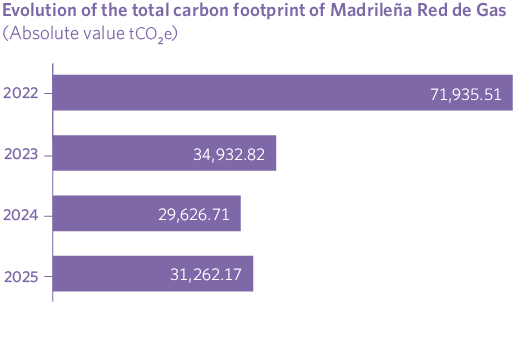
The calculation for the 2025 financial year will be subject to an external verification process by an accredited independent third party, scheduled for 2026, in accordance with the requirements of ISO 14064
This comprehensive and systematic approach reinforces Madrileña Red de Gas’s commitment to responsible climate change management, the continuous improvement of its environmental performance and accountability to its stakeholders, thereby consolidating the quality of the information used for strategic decision-making on sustainability matters.
Finally, the carbon footprint report for the previous financial year was submitted to the Spanish Office for Climate Change, obtaining the “Calculate and Reduce” seal for the 2024 financial year, which attests to Madrileña Red de Gas’s commitment to measuring, controlling and reducing its greenhouse gas emissions.
‘Calculo – Reduzco’ seal for the registration of the carbon footprint in 2024, awarded by the Spanish Office for Climate Change (OECC).
OGMP 2.0 Initiative
The Oil and Gas Methane Partnership 2.0 (OGMP 2.0) project, in which Madrileña Red de Gas has been participating since 2023, forms part of the European Strategy for the reduction of methane emissions and applies to the entire value chain of the oil and gas industry, including production, transport, distribution and processing activities.
This project has also served as a reference framework for the European Commission in drafting Regulation (EU) 2024/1787 of the European Parliament and of the Council of 13 June 2024 on the reduction of methane emissions in the energy sector. At national level, its transposition into Spanish law is currently pending, with the Ministry for Ecological Transition and Demographic Challenge (MITECO) having already been designated as the Competent Authority.
Currently, the OGMP 2.0 alliance has more than 150 member companies with assets across five continents, which together account for approximately 42% of global oil and gas production, highlighting the significance and global reach of this initiative.
In this context, Madrileña Red de Gas actively participates in the fortnightly meetings of the European Union distributors’ group, which address key issues such as defining the roadmap to achieve Level 5 ‘Gold Standard’ certification and harmonising the criteria for quantifying methane emissions. In addition, during the financial year 2025, the company attended two technical meetings held in Brussels in March and December, at which studies carried out in the academic sphere were presented and a joint analysis was conducted of the data provided by the participating distribution companies.
Madrileña Red de Gas has submitted a specific Action Plan to the OGMP 2.0, which sets out targets and actions aimed at making progressive progress in reducing methane emissions from its activities, as well as defining a clear and measurable path for continuous improvement in this area, having obtained “Gold Standard Pathway” certification for the third consecutive year.
In this regard, during the final months of 2025, the necessary steps were taken to formalise the implementation of an initial pilot project for the detection of methane emissions, based on AMLD (Advanced Mobile Leak Detection) technology, which is scheduled to be carried out in 2026, constituting a significant milestone in strengthening the company’s leak detection and management capabilities.
During the final months of 2025, the necessary steps were taken to formalise the implementation of an initial pilot project for the detection of methane emissions, based on AMLD (Advanced Mobile Leak Detection) technology
Environmental measures at LNG and LPG plants
Most of Madrileña Red de Gas’s LPG facilities fall within the scope of current regulations on soil contamination, in particular the provisions of Royal Decree 9/2005, as well as subsequent regulatory developments. In this context, the company is required to submit to the Community of Madrid the relevant preliminary soil reports, soil condition monitoring reports and, where applicable, detailed characterisation reports associated with the closure of operations.
With the aim of complying with these obligations and ensuring adequate management of environmental risk, Madrileña Red de Gas has defined a multi-year work plan, based on a prioritisation criterion that focuses actions on those facilities which, due to their operational or historical characteristics, present a higher potential for soil contamination.
In addition, during the 2025 financial year, a preliminary soil report was drawn up for the Miraflores de la Sierra LNG plant, alongside the production of various noise reports, thereby strengthening environmental monitoring of the facility and ensuring compliance with applicable regulations on soil protection and noise control.
5.4Gas Verde Sí Platform
Madrileña Red de Gas is part of the Gas Verde Sí platform, an initiative launched with the aim of promoting the development of green gas or biomethane in Spain. This platform champions green gas as a clean, viable and essential energy alternative for moving towards a more sustainable model with greater energy autonomy.
Green gas, produced from organic waste, is a 100% renewable energy source that is stable (as it does not depend on variable resources such as the sun or wind), storable and competitive. Its use helps reduce dependence on external energy sources, facilitates efficient waste management for the primary sector and promotes job creation in rural areas.
The launch of the platform was supported by various associations and companies from the primary, industrial and installation sectors, as well as representatives from the energy sector, including gas producers and distributors.
All members of the platform share the conviction that green gas represents a strategic opportunity that Spain must not miss. Furthermore, it is an open initiative, to which new organisations and professionals will progressively join with the common aim of contributing to the acceleration of the development of green gas or biomethane in the country.
Spain has the necessary conditions to become a European leader in the development of green gas, currently being the third country with the greatest production potential in Europe. To move towards achieving climate targets and strengthen both energy sovereignty and security of supply, green gas or biomethane must play a significant role within the renewable energy mix.
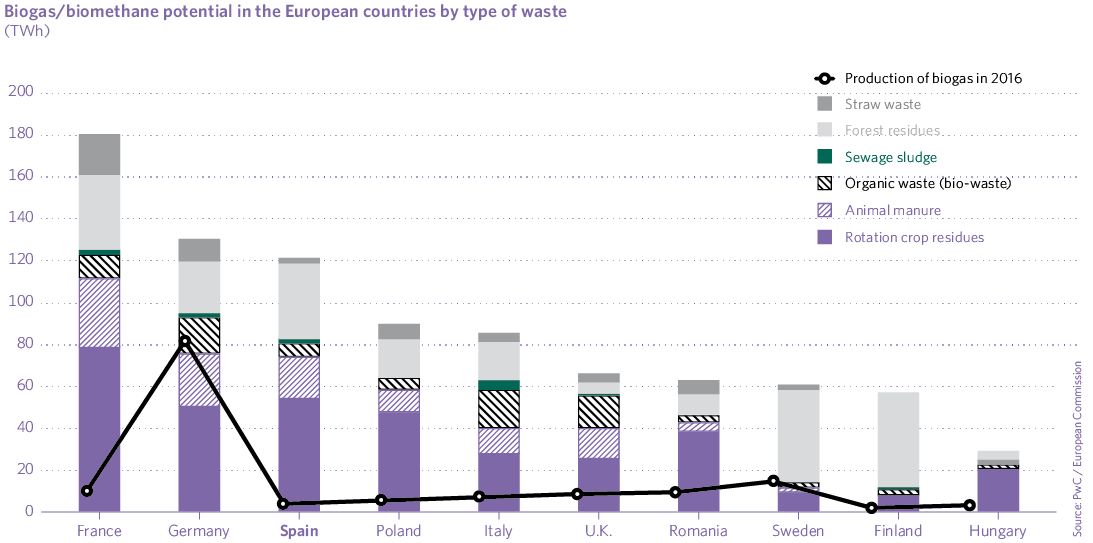
Source: PwC / European Commission.
At present, Spain lags behind the rest of Europe in the roll-out of renewable gas, trailing far behind countries such as France, Germany, Italy and Denmark. However, the country has the potential and the responsibility to position itself as a leader in this field.
Madrileña Red de Gas reaffirms its conviction that Spain can and must aim for a greater degree of energy independence and security of supply, by making use of its own resources and developing an energy mix that is appropriate for the country
Madrileña Red de Gas and the Gas Verde Sí platform argue that the energy transition cannot be considered complete without the incorporation of green gas, a renewable alternative that complements wind and solar technologies and is already fully ready for deployment. They also maintain that both individuals and businesses must have the ability to choose the clean energy solution that best suits their needs.
Similarly, Madrileña Red de Gas reaffirms its conviction that Spain can and must aim for a greater degree of energy independence and security of supply, by making use of its own resources and developing an energy mix that is appropriate for the country.
The platform calls for the implementation of an energy policy that recognises the strategic value of green gas or biomethane as a fundamental part of the renewable mix that Spain needs
The platform calls for the implementation of an energy policy that recognises the strategic value of green gas or biomethane as a fundamental part of the renewable mix that Spain needs. It also calls for a regulatory framework that promotes its development, removes existing barriers and enables households, businesses and industries to freely choose the sustainable energy alternative that best suits their needs.
Specifically, some of the measures the platform aims to promote are:
- Giving green gas a significantly more prominent role, alongside other renewable energies such as wind and solar, within national energy planning.
- Reserving a portion of the green gas supply for the industrial sector, prioritising those activities that face the greatest difficulties in decarbonising or that do not yet have viable alternatives on an industrial scale.
- Gradually introducing mandatory green gas quotas for residential gas demand, with the aim of facilitating its gradual uptake in Spanish households.
- Streamlining administrative procedures relating to the processing and granting of licences for the construction of green gas or biomethane production plants, as well as for their connection to reverse-flow facilities.
- Complete and consolidate the regulatory framework applicable to waste treatment.
- Promote the incorporation of green gas as an additional energy solution in new-build developments.
Green Gas for domestic use
Opting for green gas represents a more advantageous option for families compared to other electric energy solutions.
Choosing green gas enables progress towards a fully decarbonised housing stock, effectively contributing to the country’s climate targets, and represents a more advantageous option for families compared with other electric energy solutions. There is no installation cost for green gas in homes that already have a boiler, whereas installing electric alternatives involves a significant financial outlay for families.
Furthermore, green gas contributes to a faster and more efficient decarbonisation of homes. Promoting the use of green gas as an energy alternative also helps to reduce costs for Spanish families. In addition, biomethane enables home heating and cooling without taking up any more space than a conventional boiler, whereas other solutions, such as aerothermal systems, would require additional space that not all homes have available.
Green Gas for industry
Green gas is a clean, stable and constant source of energy, essential for industrial sectors that account for approximately 16% of GDP and employ around 3 million people, according to EPA data.
Sectors such as steel and metallurgy, cement and ceramics, the chemical and petrochemical industries, glass, the paper industry and the food sector, amongst others, will be able to use green gas to decarbonise their production processes, many of which are difficult or impossible to electrify on an industrial scale. Some of its benefits are:
- It will provide renewable, stable and continuous energy to both large and small businesses, contributing to a safer and more reliable energy mix for industrial activity.
- It will avoid high installation costs, thereby reducing the risk of industrial relocation to other countries and helping to preserve jobs and economic investment within the country.
Green Gas for agriculture and livestock breeding
In 2023, Spain ranked as the European Union country with the highest number of fines related to the improper management of environmental waste. In this context, green gas production plants represent a sustainable solution for recovering up to 120 million tonnes of organic waste generated annually, given that:
- It promotes the circular economy by facilitating the efficient reuse of agricultural and livestock waste and transforming it into renewable energy.
- It supports farmers and livestock breeders in the proper management of their waste, offering a sustainable, safe and economically viable route for its treatment.
- It helps avoid fines from the European Commission for poor waste management by providing an alternative that complies with current environmental regulations.
- It helps mitigate groundwater pollution by significantly reducing the uncontrolled dumping of organic waste and improving management practices in the primary sector.
5.5Special Projects
Inspira Madrid project
During the 2025 financial year, the Inspira Madrid project faced various operational and administrative challenges. However, significant milestones were achieved, notably the approval of the electrolyser’s electrical connection.
Following the necessary procedures and a joint analysis with the local electricity distributor regarding the actions required to enable the project’s connection to the grid, approval was obtained for the required electricity capacity reserve. This progress guarantees access to the grid in a context marked by a high volume of applications, which limits the availability of electricity capacity in other locations.
To manage the objections raised by local residents as part of the project authorisation procedure, we have collaborated with various specialist firms and environmental engineering consultancies. This coordination enabled us to prepare the necessary technical responses and address the arguments raised against the initiative, thereby ensuring the documentary and regulatory soundness of the application.
At the same time, ongoing work has been carried out with the local administration to foster institutional understanding of the project and secure the council’s support. As part of these efforts, a visit was organised to the EMT’s Entrevías hydrogen plant, where Madrid’s council team had the opportunity to see an operational hydrogen production and refuelling facility at work.
Furthermore, commercial activities aimed at identifying potential users of renewable hydrogen were stepped up. To this end, contacts were established with leading companies in sectors such as logistics, food distribution and passenger transport, amongst others. These actions seek to drive the decarbonisation of mobility in the Community of Madrid and encourage the adoption of sustainable energy solutions.
The accumulated delay in obtaining permits has made it necessary to request an extension to the project’s implementation schedule from CINEA (European Climate, Infrastructure and Environment Executive Agency), the body responsible for managing funding under the CEF Transport programme. CINEA granted this extension, providing a longer timeframe to complete the development phases prior to the construction of the hydrogen production plant.
Looking ahead to 2026, significant progress is expected both in the administrative processes related to permits and in identifying potential consumers for the renewable hydrogen that will be generated. At the same time, the feasibility of alternative locations for the plant continues to be assessed, in the event that it is not possible to carry out the project at the currently planned site in Villanueva del Pardillo.
Looking ahead to 2026, significant progress is expected both in the administrative processes related to permits and in identifying potential consumers for the renewable hydrogen that will be generated
Hydrogen boiler
For a period of two years, a domestic boiler designed to run on 100% hydrogen has been in operation at the Madrileña Red de Gas offices. The unit has demonstrated full availability throughout its operational period, using hydrogen supplied via cylinders to provide domestic hot water and heating to one of the rooms.
Throughout the operational period, there have been numerous visits from official bodies, companies in the energy and technology sectors, as well as various universities. These visits have made it possible to verify and demonstrate that hydrogen-based heating is technically viable in a real-world setting.
The equipment transfer agreement with Vaillant has come to an end, which is why the boiler has been removed by the manufacturer. Looking ahead to 2026, the plan is to continue the collaboration with Vaillant to provide a natural gas boiler adapted using a conversion kit that will enable it to run on 100% hydrogen. This phase represents a further step in demonstrating that current natural gas boilers, designed to accommodate mixtures containing up to 20% hydrogen, can be modified to run entirely on hydrogen.
The plan is to continue the collaboration with Vaillant to provide a natural gas boiler adapted using a conversion kit that will enable it to run on 100% hydrogen
«Pryconsa»
The installation of the hydrogen-ready equipment is scheduled for 2026. This boiler is capable of adapting to and operating on different mixtures of hydrogen and natural gas. Connected to the Madrileña Red de Gas distribution network, the unit will begin operating using natural gas and, as it is technologically equipped for hydrogen use, will be able to consume green hydrogen when it is available or when required. This initiative represents a further step in the validation of hybrid technologies and the progressive decarbonisation of heating systems in the residential sector.
ECO Label
The ECO Label initiative for natural gas boilers is a project promoted by Madrileña Red de Gas with the aim of informing domestic consumers about the decarbonisation potential associated with their current heating systems. The aim of the initiative is to:
The ECO Label initiative for natural gas boilers is a project promoted by Madrileña Red de Gas with the aim of informing domestic consumers about the decarbonisation potential associated with their current heating systems
- Inform consumers: it allows users of natural gas boilers to know that their equipment is compatible with more sustainable fuels, without the need for additional investment or replacing the existing installation.
- Facilitate the energy transition: it demonstrates that decarbonising the domestic sector does not necessarily require complex building work or the replacement of current appliances. The initiative highlights the “ease of transition” and the “zero cost” to the user in relation to adapting their installation to renewable gases.
- Connect users with technical information: each label features a QR code that directs users to the Madrileña Red de Gas website, specifically to the section dedicated to new energies. From there, they can access detailed information on renewable gases, such as biomethane and hydrogen, and check their boiler’s compatibility with these energy sources.
Inspired by the environmental labels used in the automotive sector, this label is a physical sticker affixed to domestic natural gas boilers. Its purpose is to clearly and accessibly communicate that the equipment is compatible with renewable gases, such as biomethane and green hydrogen (up to a certain percentage).
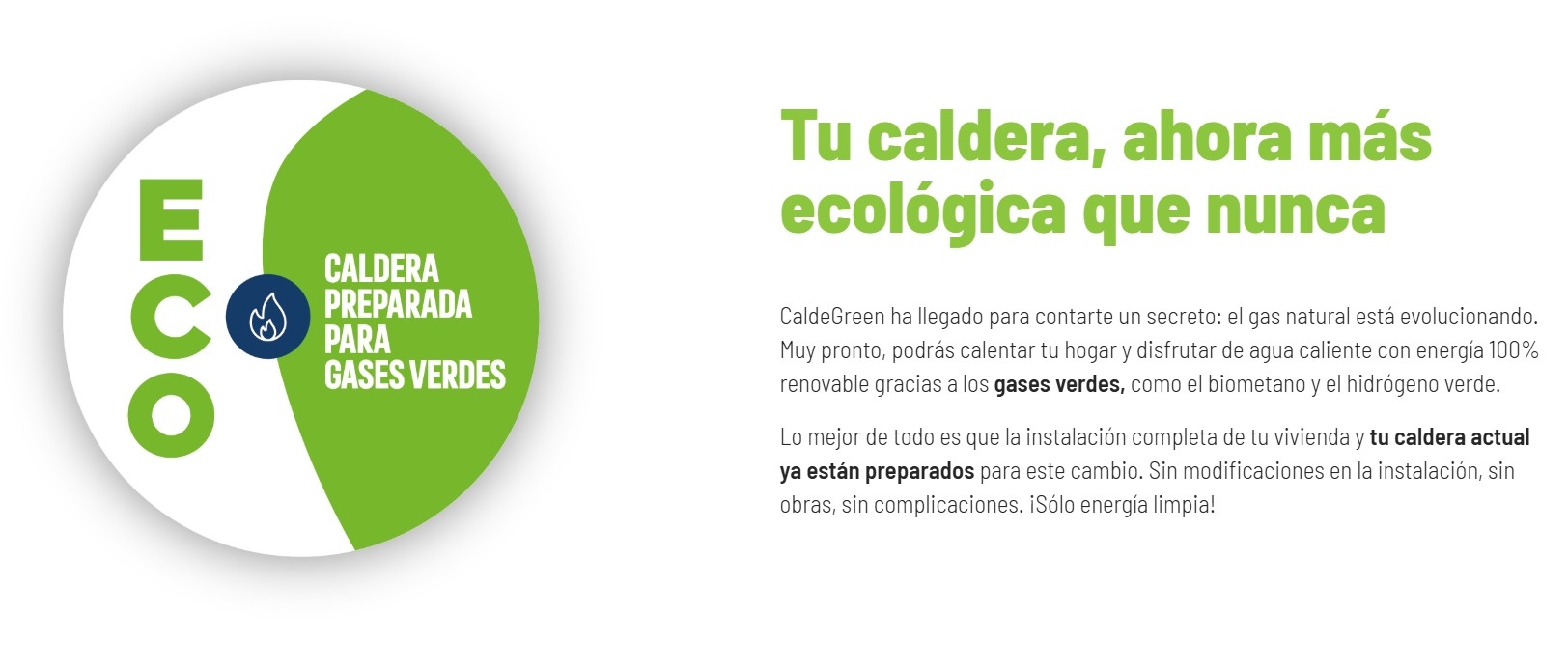
Each label features a QR code that links to the Madrileña Red de Gas website, where users can check whether their natural gas boiler is compatible with renewable energy sources such as biomethane or hydrogen
The label is being affixed during the standard processes for connecting to the supply network, converting LPG installations and carrying out periodic inspections.
Our customers can check whether their boiler is compatible with biomethane or even green hydrogen in Madrileña Red de Gas’s website.
5.6Gas Infrastructure Positioning
In the context of the conclusion of the second regulatory period, PwC has produced a report at the request of SEDIGAS, in which Madrileña Red de Gas has actively participated. This report analyses the role and positioning of gas infrastructure, as well as the evolution of the regulated sector during this second regulatory period.
The document highlights the essential role played by natural gas within the Spanish energy system, both for its contribution to security of supply and for its ability to effectively support the decarbonisation process.
In the domestic sector, the number of supply points has remained stable, serving millions of households that use natural gas for heating, domestic hot water and cooking. For approximately 85% of these consumers, natural gas remains the most efficient option today, whether due to technical limitations preventing access to other solutions, such as heat pumps, or economic constraints hindering the replacement of existing equipment and systems. This situation makes natural gas a key element in ensuring a fair, affordable and progressive energy transition.
For approximately 85% of these consumers, natural gas remains the most efficient option today
In the industrial sector, natural gas plays a critical role in the competitiveness of a wide range of industries, contributing directly and indirectly to a significant share of GDP and national employment. Numerous energy-intensive sectors rely on gas for strictly technical reasons — such as the need to reach high temperatures, ensure continuity of supply or maintain product quality — and do not have, in the short to medium term, viable alternatives that are technically and economically reasonable. In this regard, natural gas plays a central role in the continuity of industrial activity and the preservation of strategic value chains.
In the services sector (healthcare, hospitality, retail, SMEs, among others), natural gas is also an essential energy carrier for ensuring the operation of basic and critical services. Its use provides operational flexibility, rapid response times and reliability in meeting peak demand, elements that are indispensable for guaranteeing the continuity and quality of these services.
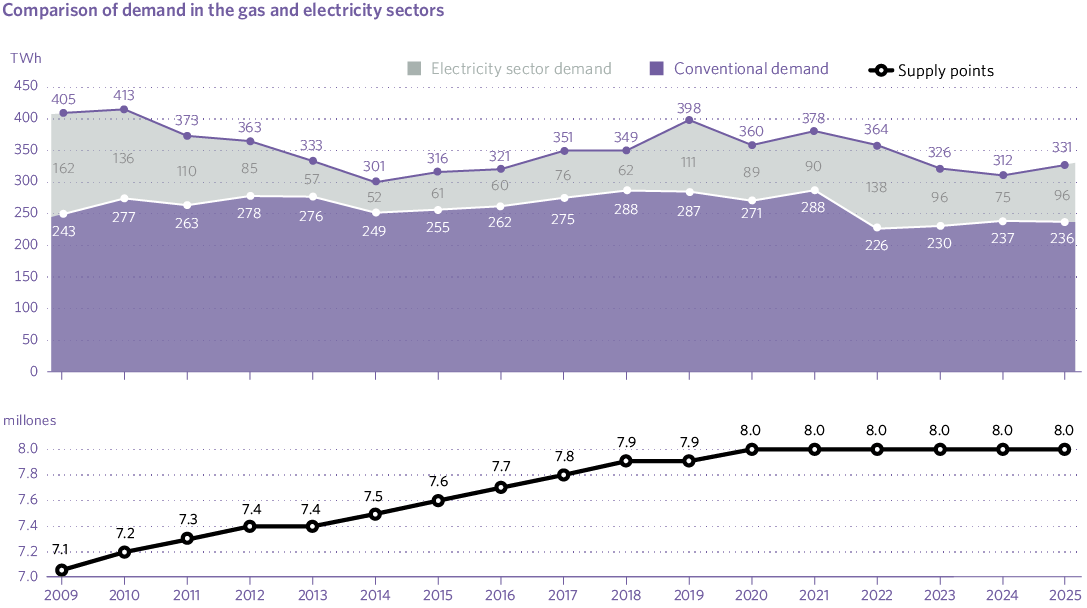
The report highlights those renewable gases, primarily biomethane and renewable hydrogen, are emerging as the most efficient and competitive route to decarbonising the demand currently met by natural gas. For the majority of domestic consumers, decarbonisation supported by biomethane is the most economically efficient option and, in many cases, the only technically feasible one without requiring very heavy investment in replacing internal equipment and infrastructure, as it allows existing equipment (boilers) to be utilised rather than having to invest in electric alternatives. Similarly, in industrial and service applications, the gradual injection of renewable gases into the existing network enables emissions to be reduced at a lower social and economic cost than other alternatives, whilst preserving security of supply.
The report highlights those renewable gases, primarily biomethane and renewable hydrogen, are emerging as the most efficient and competitive route to decarbonising the demand currently met by natural gas
Taken together, natural gas and renewable gases form an essential lever for reconciling decarbonisation targets with economic competitiveness, territorial cohesion and the protection of vulnerable consumers.
Furthermore, the report emphasises the strategic importance of gas infrastructure.
Spain’s gas infrastructure is one of the most comprehensive and robust systems in Europe, comprising nearly 100,000 km of transmission and distribution networks, seven regasification plants, three underground storage facilities and international interconnections.
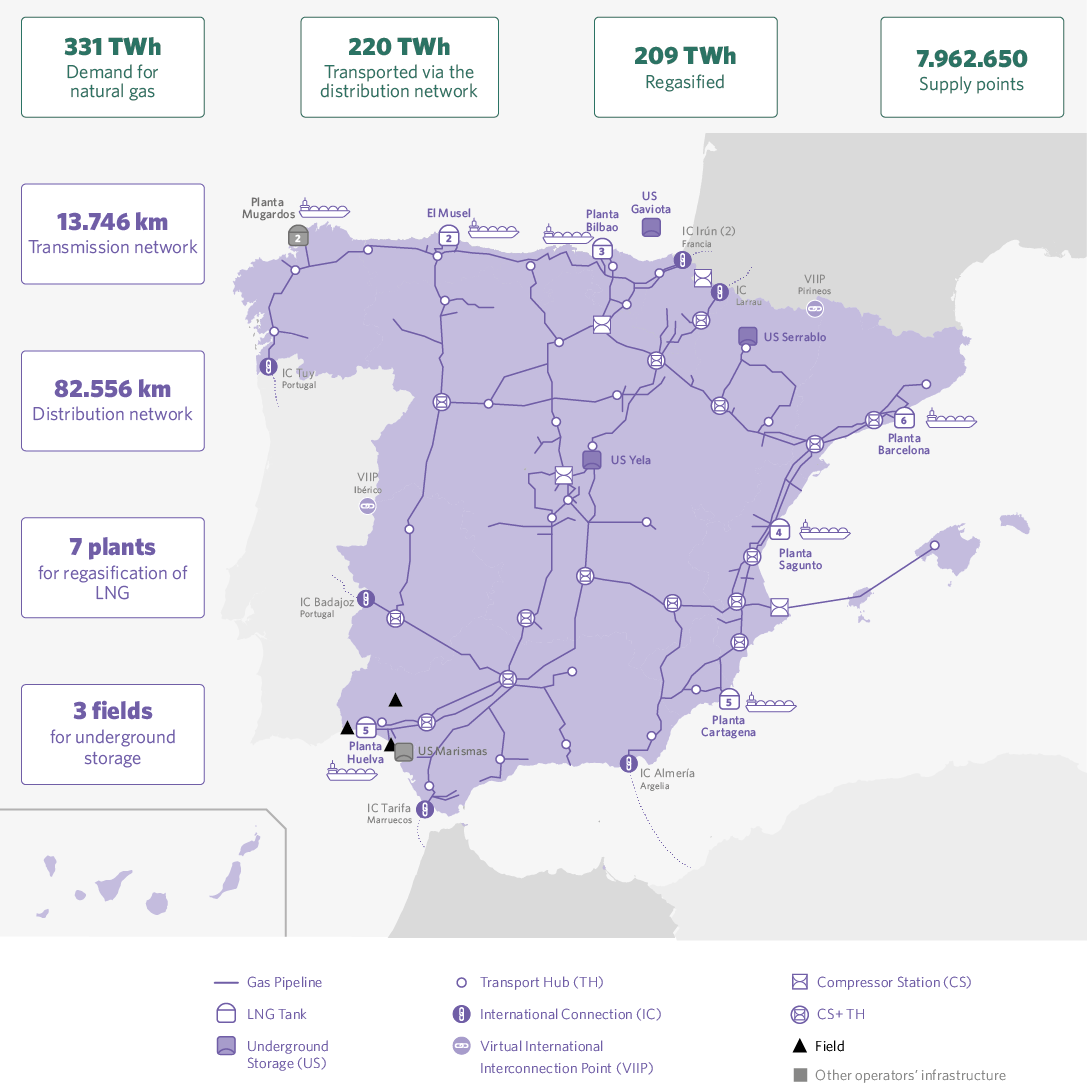
This network of physical assets, the result of significant cumulative investment over recent decades, has become a strategic infrastructure for the country. From the point of view of security of supply, the gas system offers a high degree of diversification in terms of supply sources and routes. The combination of liquefied natural gas received at regasification plants with supplies via pipeline allows the supply mix to be adapted flexibly in response to geopolitical changes, occasional disruptions or crisis situations, helping to ensure a continuous supply to households, businesses and critical facilities.
The meshed configuration of the network, thanks to the distribution and transmission networks, together with storage capacity and operational management capabilities, provides the system with remarkable resilience against adverse weather events, seasonal demand peaks and contingencies in the electricity system, whilst enabling combined-cycle power stations to perform an essential back-up and flexibility function for the electricity system.
In the context of decarbonisation, the existing gas network is the ideal vehicle for transporting renewable gases, avoiding the need to build entirely new infrastructure. Spain has one of the highest biomethane production potentials in Europe (~163 TWh/year), which opens the door to a gradual replacement of fossil gas with renewable gas by taking advantage of the capillarity and extent of the current networks. This development would not only enable the decarbonisation of final demand across multiple consumer sectors (domestic, industrial, services, mobility), but also strengthen national energy self-sufficiency by utilising domestic resources.
In this way, the gas infrastructure fulfils a threefold role: it guarantees security of supply, enables efficient decarbonisation via renewable gases, and helps reduce external energy dependence, positioning Spain as a potential clean energy hub within the European context.
The report also analyses the sector’s evolution during the second regulatory period. The current regulatory period (2021-2026) has been marked by an exceptionally complex economic and financial environment, with notable increases in macroeconomic price indices (CPI and IPRI) and the cost of debt. These factors have directly affected the operating and maintenance costs of gas networks and assets, as well as the financing of the investments necessary to guarantee the security and quality of service.
In this context, the trend in gas tariffs, determined on the basis of the recognised remuneration for the regulated activities of distribution, transmission and regasification, has led to a significant mismatch with the sector’s actual costs and with the trend observed in other countries in our European environment.
With regard to distribution activities, the reduction in the recognised remuneration is largely explained by regulatory adjustments to the remuneration base, as well as by temporary falls in demand for natural gas during the period (COVID, the war in Ukraine, etc.).
On the other hand, in transmission and regasification, the reductions in remuneration are related, amongst other factors, to the downward trend in certain regulatory parameters that affect the remuneration recognised for these activities. The reduction in revenue from gas sector activities is also occurring at a time when gas infrastructure is called upon to play an enhanced role in managing security of supply and in preparing for the integration of renewable gases.
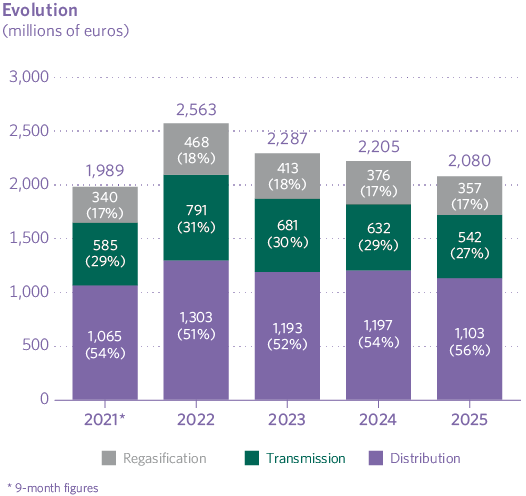
This combination of factors—an adverse macroeconomic environment and changes to the remuneration framework—may have negative effects on the stability and reasonable profitability of these activities. All of this reinforces the need for the regulatory design to evolve towards a framework that provides appropriate signals and offers sufficient visibility and certainty to market participants over the next six years.
In this context, the report identifies a number of elements of the current regulatory framework for gas infrastructure that shape its role and pose significant challenges. Firstly, it is noted that the current remuneration model was designed in a scenario prior to the acceleration of the energy transition and before the recent episodes of volatility in energy markets. As a result, certain parameters and methodologies may not adequately reflect the reality of costs, the need for additional resilience and the new strategic role of gas infrastructure, both for security of supply and for the integration of renewable gases.
Secondly, the current framework does not always fully internalise the intrinsic value that gas infrastructure brings to the energy system as a whole. The contribution of the gas system to the stability of the electricity system, to the back-up of renewable energy, to security of supply in times of stress and to the diversification of sources and routes is not directly reflected in the regulated remuneration. This can create a gap between the social and economic value that this infrastructure provides and the remuneration it receives.
Thirdly, regulation must address the challenge of reconciling the necessary recovery of sunk costs and the protection of investments made with the gradual adaptation of the network to a scenario of greater penetration of renewable gases and possible changes in demand for fossil gas. This involves designing mechanisms that allow the transition to be managed in an orderly manner, whilst ensuring that infrastructure can evolve towards new uses and services.
The report emphasises the need for regulation to take into account the European and international dimension of the gas sector, in a context where Spain can play a significant role as a gateway for gas and renewable gases into the European market
It also highlights the importance of the regulatory framework providing stability, predictability and clear long-term signals. Investments in gas infrastructure, including its adaptation to renewable gases, require long time horizons and reasonable certainty regarding the rules of the game, accompanied by clear and reasonable economic signals, so that market participants can plan ahead and mobilise the necessary resources.
Finally, the report emphasises the need for regulation to take into account the European and international dimension of the gas sector, in a context where Spain can play a significant role as a gateway for gas and renewable gases into the European market. Proper coordination between national and EU policies, as well as consideration of interconnections and projects of common interest, is essential to maximise the value of Spanish infrastructure and contribute to the European Union’s security and sustainability objectives.